
Radical Geek field note
Beyond the Prompt: Context Is the Why Behind Every Decision
Prompting tells an AI what to do. Context tells it why the work matters, what has already been decided, and what boundaries it must respect.
Originally published on LinkedIn in January 2026.
When people talk about AI context, they often mean the technical definition: the information attached to a model request. Files, snippets, messages, examples, logs. That definition is accurate, but incomplete.
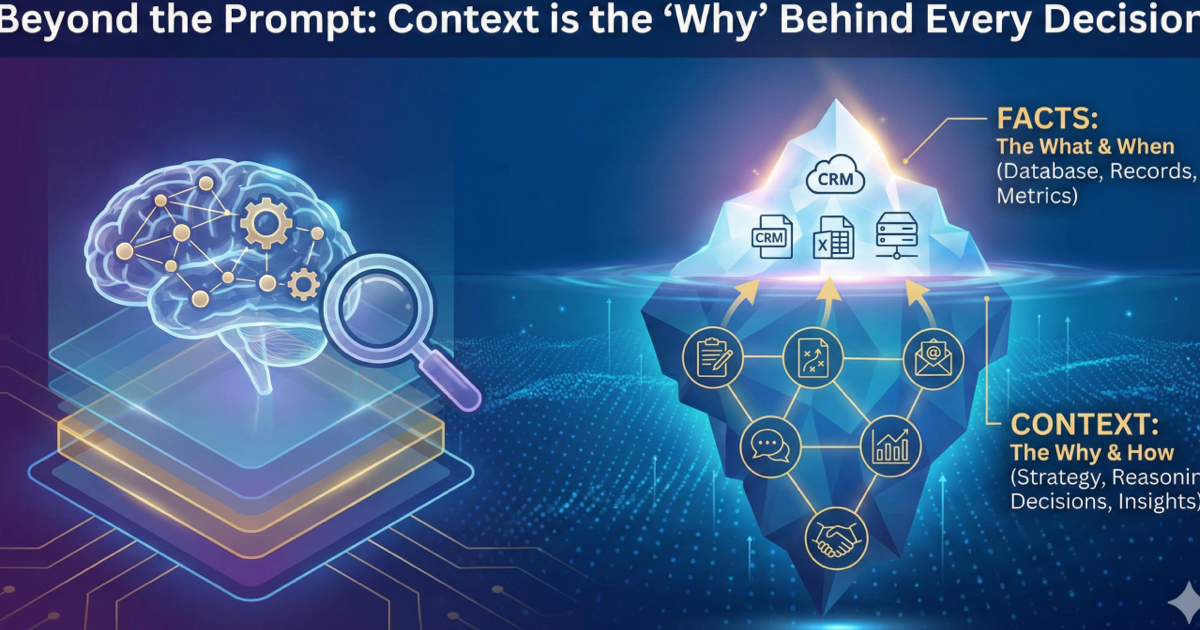
In engineering work, context is the why behind a decision.
A prompt can tell an AI what to do. Context explains what has already happened, why the system is shaped the way it is, which trade-offs have been accepted, and which boundaries matter.
Without that, the model can still produce code. It just may not produce the right code for this system.
Prompts Are Instructions. Context Is Situation.
“Add validation to the registration endpoint” is a prompt.
The context is everything around it:
- this service uses Zod, not Joi
- errors must be returned in a shared envelope
- validation messages use British English
- the endpoint is used by a mobile client that treats 409 specially
- an earlier attempt broke account recovery
- security review requires audit logging for rejected registrations
That is the difference between generic output and situated engineering.
Context Carries Constraints
Good engineers do not make decisions in a vacuum. They operate inside constraints: architecture, platform, team conventions, compliance, deployment risk, cost, and user impact.
AI agents need the same constraints. If they cannot see them, they will infer their own.
That is why context engineering matters. It is not decorative prompt craft. It is the discipline of deciding what the agent needs to know, what it should ignore, and how the information should be structured so the model can act usefully.
The Wrong Context Is Worse Than Too Little
More context is not automatically better. A huge context window filled with irrelevant files, stale notes, generated output, and noisy logs can make the model less reliable.
The model pays attention unevenly. Important material buried in the middle may be underweighted. Contradictory instructions can pull behaviour in different directions. Old decisions can be mistaken for current ones.
The craft is not “include everything”. The craft is context selection.
Durable Context Beats Repeated Explanation
If humans have to re-explain the same decisions every time an agent starts work, the system is not learning. It is just borrowing human memory.
Durable context changes that. Store the decisions. Keep the caveats. Preserve the runbooks. Mark superseded assumptions. Retrieve what matters when it matters.
That is how agentic engineering becomes cumulative instead of repetitive.
The Shift
The industry has spent a lot of time teaching people to write better prompts. That was useful, but it is not enough.
The next skill is context engineering: building the conditions in which AI tools can make better decisions because they understand the situation they are operating inside.
The prompt asks for the change. Context tells the agent what kind of change would be wise.