
Radical Geek field guide
Radical Geek's Guide to Governing AI And Agentic Systems
A practical operating guide for qualifying AI use, governing delegation, preserving human accountability and creating a sanctioned path to value.
Why this guide
Radical Geek’s research found that organisations which established governance early moved faster. Teams had a sanctioned route for selecting, designing, authorising, observing and improving AI-supported work, with known decision rights and evidence requirements.
This guide turns that operating advantage into a practical governance capability spanning leadership, enterprise architecture, platform engineering, security, data, assurance, product delivery, people and economics.
It provides operational guidance for accountable AI use. Organisations should interpret legal, regulatory and sector obligations with appropriately qualified specialists.
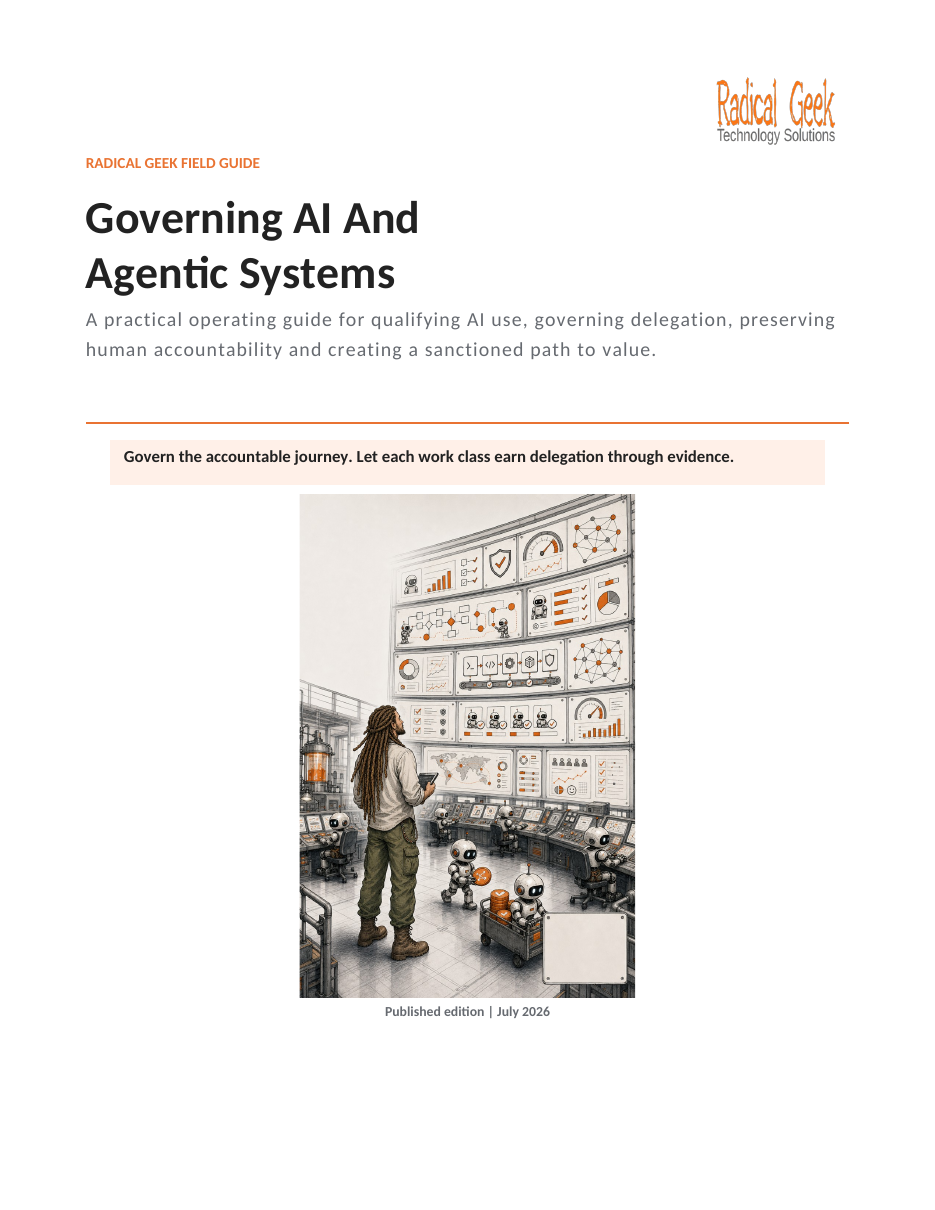
Govern the accountable journey. Let each bounded work class earn delegation through evidence.
What you will leave with
A guide built to be used.
- 01
Create one evidence-led route from use-case intake and qualification through authorisation, operation, change and retirement.
- 02
Assess consequence and delegability separately so oversight and earned AI participation remain explicit.
- 03
Use Proof of Operation to qualify representative work, exceptions, context gaps, escalation and validation effort.
- 04
Turn policy into operating controls across identity, permissions, routing, data, workflow state, evidence and recovery.
- 05
Connect assurance, full cost, human effort and tail behaviour to accepted, accountable outcomes.
Inside the guide
The working ground it covers.
- Governance as an operating capability
- The AI governance lifecycle
- Consequence, delegability and Proof of Operation
- Governance architecture and control domains
- Data, context, RAG, verification and assurance
- Economics, metrics, people and decision rights
- A 90-day implementation and reusable templates